








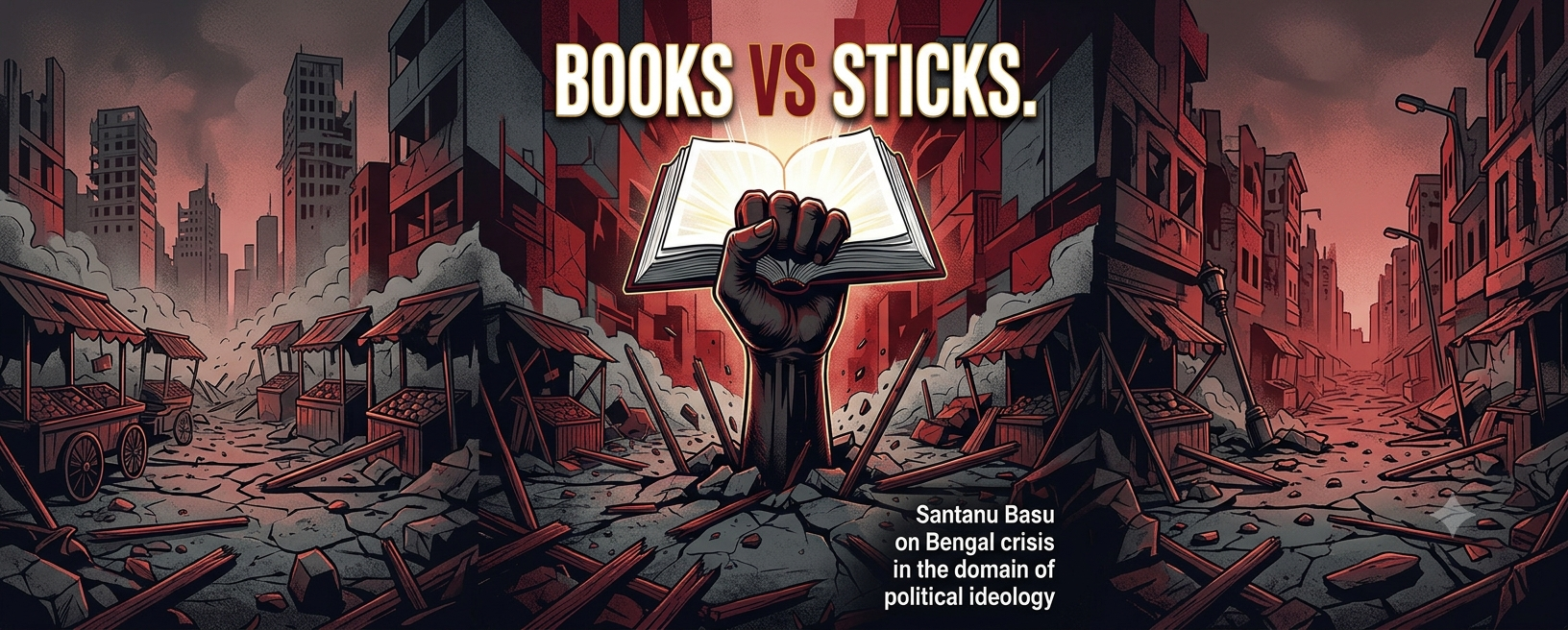
In the long history of the Rashtriya Swayamsevak Sangh (RSS) and the Bharatiya Janata Party (BJP), it is difficult to recall many instances of opposition political campaign stalls being systematically vandalised and razed to the ground on the scale witnessed across the districts of West Bengal during this year’s Durga Puja festivities. For the last fifty sixty years , the Left Organisations leaned heavily on the propagation of its own literature among the people with the ostensible purpose of dissemination of knowledge from its own perspective.
Obstructing opposition political campaigns, forcibly occupying their party offices, tearing down their flags and banners, and, above all, brutally assaulting opposition workers—leaving them grievously injured and hospitalised—were once the hallmarks of the CPI(M)’s politics of domination in West Bengal. Yet, barely five or six months after coming to power, has the BJP already succumbed to the very same political disease that once consumed the CPI(M)? Has it become so intoxicated with power, so blinded by ideology, so intolerant of dissent, and so bereft of political direction that it has descended into a frenzy of destroying even the bookstalls of its opponents?
When political power turns against books, the crisis is no longer merely political; it becomes a crisis of civilisation itself.
This Kalapahari-like rampage of destruction, directed not merely against political opponents but against books and the spaces in which ideas are exchanged, is enough to send a shudder down the spine of anyone who values knowledge, reason and intellectual freedom. Under no circumstance , such mayhem upon books of any orientation is permissible.
Have ignorance, confusion, political disorientation and intellectual bankruptcy taken such a deep hold of the party’s rank and file? The BJP, the RSS, the Hindu Mahasabha, the Swadeshi Jagran Manch and organisations associated with the Vanvasi Kalyan Samity must surely be aware of this orgy of destruction. And yet, where is the protest? Where is the unequivocal condemnation? Where is the moral outrage ? It is not that the RSS or the BJP lacks a substantial body of party literature, unlike its counterparts in the Congress or the Trinamool Congress. On the contrary, the BJP has an established intellectual and publishing apparatus that produces hundreds, if not thousands, of books on Hinduism, Hindu politics, the Vedas, the Upanishads, and the evolution of the Hindu identity. From Deendayal Upadhyaya to numerous RSS and BJP scholars, ideologues, and stalwarts, a vast body of literature has emerged critiquing the politics of the Congress and articulating the BJP’s own perspectives on Indian foreign policy and national affairs.
Given this extensive intellectual and literary legacy, it is all the more perplexing to witness the current spate of political violence against ideological and political opponents, particularly the CPI(M) and the SUCI. The contradiction raises a fundamental question: how can a political movement that has invested so heavily in ideological discourse and intellectual production reconcile such a legacy with the resort to violence against its rivals?
When books are attacked and the guardians of ideology remain silent, that silence itself becomes a political statement.
Mohan Bhagwat Ji, the most revered leader of the RSS, visited Burdwan city only a short while ago to oversee the organisational activities of the RSS. Surely, he must have heard about the widespread attacks on opposition parties in villages and towns, as well as the conspicuous inaction of the police. Has he issued any clear and unequivocal directive asking his organisation’s workers to exercise restraint, abandon violence and desist from intimidating political opponents? The RSS and the BJP wield enormous influence across much of India. A clear message from their highest leadership could have helped restrain these elements and prevent further violence. Yet no sufficiently forceful message has emerged. The silence is all the more disturbing because this is precisely the moment when leadership should be measured not by its capacity to mobilise followers, but by its willingness to restrain them.
The West Bengal BJP president, Shamik Bhattacharya, and Swapan Dasgupta, the state finance minister who can well be identified as a senior political figure close to the RSS, have made a few statements that appear designed to distance the leadership from the controversy. To me, however, these statements sound like the ritual chanting of a priest: words uttered without conviction, substance or moral force. They lack the firmness and clarity that a genuine denunciation of political violence demands.
There is a calculated artfulness in Shamik Bhattacharya’s choice of words. He insists, repeatedly and emphatically, that those involved in vandalising the stalls are not BJP members. He has, it seems, returned to the assertion that “none of them belongs to the BJP” time and again. It’s simply political chicknery or verbal wrestling far away from hard reality. It is the BJP workers , might be infiltrators from Trinamool Congress , are the main culprits vandalising numbers of political campaign stalls belonging to the CPI(M) or SUCI another left outfit, in West Bengal.
But the central question cannot be evaded merely by repeating a denial. Fanatical activists whose political allegiance has overwhelmed their capacity for independent judgement. The English language has an apt word for such people: bigots.
And herein lies the tragedy of politics built upon blind allegiance. Leaders who depend on unthinking followers , better speak ‘robot’ followers have little inspiration to cultivate rationality, intellectual independence or moral courage among them. A politically conscious and intellectually independent worker might question a leader’s instructions, challenge wrongdoing or refuse to participate in violence. A blindly obedient follower is far easier to mobilise. Who, then, would smash party offices, burn political establishments or assault opposition workers if every party activist were guided by reason and conscience rather than unquestioning loyalty? Today, BJP workers are reproducing the very brand of coercive, CPI(M)-style politics that their party once denounced, allegedly with the police standing alongside them.
Shamik Bhattacharya, the president of the BJP in West Bengal, does not play short passes on the political field ; he prefers long shots. His statements are carefully calibrated, his rhetoric artfully modulated, and his choice of words seemingly designed to create distance between the party leadership and the actions of its own supporters and create more confusion than clear action. Actually to obfuscate the truth , he resorts to mimicry or other tactful ways generally detested by sagacious political workers or leadership.
Yet the essential point remains unanswered: where is the unambiguous condemnation of the destruction itself? He did not, directly and unequivocally condemn the vandalism of the stalls. Nor did he express the kind of indignation that such an attack on political expression and the freedom to disseminate ideas ought to provoke. Instead, he suggested that even BJP workers living far away would never engage in such acts.
But the people of Jadavpur and countless others across West Bengal have seen what happened to the stalls belonging to Left-wing parties, including the CPI(M). They know how books were flung out onto the streets, how display tables were smashed, and how the written word was treated with contempt by those who appeared incapable of appreciating its worth. Alas, you unfortunate people! You do not even understand the enormity of what you are doing.
According to the Biblical account, as Jesus Christ was being crucified, he prayed, “Father, forgive them; for they know not what they do.” The words resonate painfully in the present context. To hurl books to the ground, smash the tables on which they are displayed, and attack them with kicks, sticks and blows is not merely an act of vandalism. It is an assault upon learning, reason and the very possibility of civilised disagreement.
A bookstall may be small. The ideas it carries may be unpopular with those who destroy it. But no political disagreement, however intense, can justify the destruction of books or the intimidation of those who seek to share them. Barely five months after coming to power, BJP workers are already being accused of participating in such destructive acts. What, then, has become of the promise of political change? Has the transfer of power merely changed the identity of those wielding the stick, while leaving the underlying culture of intimidation untouched? A book cannot be defeated by a stick. An argument cannot be disproved by a broken table. An idea cannot be erased by throwing its printed expression into the gutter. Such acts do not demonstrate strength. They expose insecurity—the fear of ideas that cannot be controlled and arguments that cannot be answered.
One wonders whether those who participate in such acts are even familiar with the distinguished figures associated with their own party. Have they heard of Arun Jaitley, Sushma Swaraj or Manohar Parrikar, after whom the Manohar Parrikar Institute for Defence Studies and Analyses is named? Sushma Swaraj’s daughter, Bansuri Swaraj, is an advocate practising before the Supreme Court. Late Arun Jaitley’s son chooses the same vocation in the Supreme Court . Rather than smashing stalls and hurling books into the dust in Kolkata , BJP workers would do better to learn from those who have pursued public life through education, legal reasoning, intellectual engagement and institutional responsibility. Watching people roam about with sticks and bamboo poles, fighting both indoors and outdoors, one is reminded of a bitter truth:
Monkeys revel in their monkey business; we human beings are left hanging our heads in shame.And so we return to the same dismal conclusion. If political workers do not crack the skulls of their opponents or leave them permanently disabled, what, in this distorted understanding of politics, makes them political workers at all? And only appreciated by their leaders ! This is the perverse logic to which parties risk surrendering when they mistake aggression for commitment, violence for courage and blind obedience for loyalty.
A political party that needs its workers to break heads, burn offices and destroy books has failed not only its opponents but also its own people.
The destruction of opposition political stalls, of course, is not a new phenomenon. Long before the BJP emerged as a significant political force in West Bengal, such acts of political intimidation had already become part of the state’s troubled history. In those days, there were only a handful of deeply committed RSS workers and scattered shakhas across different parts of West Bengal. They carried with them the painful memories of Partition, a historical wound that had left deep scars on countless lives.
Few people remain today who can recount how the CPI(M) used to demolish stalls belonging to the Socialist Unity Centre of India (SUCI). Many eyewitnesses to the persecution suffered by SUCI have passed away. The few SUCI workers who survive, continuing to carry the red flag from door to door, remain among the witnesses to the brutality they say they endured during the CPI(M)’s years in power.
According to very reliable sources , at least fifty SUCI leaders and workers were shot or hacked to death by CPI(M)-affiliated miscreants in areas including Jaynagar, Kultali and Mathurapur in South Bengal.
Anyone can recall how notorious figures such as Sheikh Shahjahan of Sandeshkhali, Shaukat Molla of Canning and Arabul Islam operated in an environment allegedly protected by the CPI(M) and the police , who smashed the houses of the villagers , set fire in poorer’s hamlets and what not ! Villagers supporting opposition parties faced intimidation and wrath , while poor farmers’ homes, cowsheds and granaries filled with paddy were reportedly destroyed or set ablaze.
Opposition parties would approach CPI(M) chief ministers with deputations, pleading for protection from the violence and intimidation associated with figures such as Shaukat Molla and Arabul Islam or their ilk of CPI(M)!Eventually, it became evident , notorious political elements associated with the CPI(M) found shelter under the Trinamool Congress. And where was the BJP in those days?
The historical irony is difficult to ignore. A party that once positioned itself as an alternative to the coercive political culture of its predecessors now faces accusations of reproducing the very practices it condemned.
In West Bengal, the faces of political power may change, the colours of party flags may change, and the slogans may change—but the culture of intimidation survives whenever a ruling party begins to treat dissent as an enemy to be crushed.
Now, having come to power, the BJP appears, in the author’s view, to have allowed confused, directionless, unruly and brutal elements to turn the destruction of political stalls into a spectacle of power.What depth of ignorance, ideological blindness and intellectual impoverishment must prevail for anyone to imagine that smashing a bookstall is an act of political strength? Students and young people, return to your books. Return to your schools, colleges and universities. Find your way back to the libraries. Open the pages of books and allow your minds to breathe.
Cultivate reason. Develop independent judgement. Seek the tranquillity that comes from knowledge and reflection To squander one’s intelligence, intellect and capacity for independent thought in blind pursuit of the self-serving, manipulative and opportunistic leaders of political parties is nothing short of self-destruction. At the very least, learn Bankim Chandra Chattopadhyay’s Vande Mataram by heart—not merely as a slogan to be shouted, but as a literary and cultural work to be understood and appreciated from the depths of your heart.And above all, do not take up sticks and bamboo poles to attack another human being. A young person’s hands should hold books, not weapons. The mind should be trained to question, not conditioned to obey blindly. Political commitment should deepen one’s humanity, not extinguish it. Saving Books and
Libraries: A Struggle Across the Ages
From the distant past to the present day, the pages of history are filled with extraordinary accounts of people who have risked their lives to preserve books, defend libraries and protect the accumulated knowledge of humankind. Books are not merely paper bound together. They are repositories of memory, reason, imagination and experience. Libraries are not simply rooms filled with shelves; they are sanctuaries in which humanity preserves its intellectual inheritance. To attack a library is to attack the continuity of human civilisation itself.
About a decade ago, when militants of the Islamic State (ISIS), one of the most fanatical extremist organisations of that period, attacked the library in Palmyra, Syria, a librarian reportedly fought with all his strength to protect it.But the blades of the ISIS executioners struck him down. His spectacles were flung from his face, and the horrifying image of his bloodied head lying on the library floor spread across the world.
The tragedy was not merely the murder of a librarian. It was the brutal confrontation between those who seek to preserve knowledge and those who seek to dominate through fear, ignorance and destruction. More recently, according to the account cited by the author, another librarian in Syria concealed books within the walls of a building to protect them from religious extremists. Following a change in circumstances, he recovered the hidden volumes and returned them to the shelves of the library.
What a powerful act of defiance! When books could not be protected openly, they were hidden. When the danger passed, they were brought back into the light. The books survived because someone understood that preserving knowledge was worth the effort, the risk and the patience it demanded.
The image of the Syrian librarian’s bloodied head on the floor of a library evokes a deeply disturbing parallel with the horrific sight of a headmaster at a government school in Jalpaiguri, West Bengal, lying on the school grounds with his head grievously injured and blood flowing from his wounds.
It would be inappropriate to equate the fanatical militants of the Islamic State directly with the handful of alleged miscreants involved in the Jalpaiguri incident. The circumstances and scale are different. Yet the moral question raised by both episodes is unavoidable:
what happens to a society when violence overwhelms the institutions that are supposed to preserve knowledge, discipline and humanity?
What could be more horrifying than seeing a headmaster—an educator entrusted with guiding the young—lying injured on the very grounds of the institution he serves? The incident reportedly arose from a dispute over the serving of meat in the midday meal on Teachers’ Day. The details are disturbing enough. But what makes the episode even more heartbreaking is the account that, while the assailants were beating the headmaster and inflicting severe injuries upon him, other teachers stood on the veranda watching the violence unfold.
If this account is accurate, it raises an uncomfortable and urgent question about professional responsibility and moral courage. Alas, the teaching community! Is the duty of an educator exhausted by collecting a monthly salary? Is a teacher’s responsibility confined to completing the syllabus, marking attendance and returning home at the end of the working day? A teacher is not merely an employee drawing a salary. A teacher is a guardian of knowledge, a custodian of the intellectual and moral development of the young, and, in moments of crisis, a potential defender of human dignity.
When a colleague is attacked, when a headmaster lies bleeding on school grounds, and when violence unfolds before the eyes of those entrusted with education, silence cannot be dismissed as an insignificant detail. The circumstances may constrain what individuals can safely do, and responsibility must be assessed fairly. Nevertheless, the larger question of institutional courage cannot be avoided. What example does a school set when violence becomes possible within its walls? What lesson do students learn when the people entrusted with their education appear powerless, indifferent or unwilling to intervene?
Political violence, the destruction of bookstalls, attacks within schools, and the domination of colleges by hooliganism and intimidation are not isolated phenomena. They are connected by a common thread: the erosion of respect for reason, institutions, dissent and human dignity. When political rivalry becomes an excuse for brutality, when books are treated as enemies, when educational institutions become arenas of intimidation, and when those in positions of responsibility fail to respond adequately, society begins to lose something far more valuable than public order.
It begins to lose its moral compass. The question, therefore, is not merely who will be arrested or what punishment will be imposed. Justice must certainly be pursued, and those responsible for criminal acts must be held accountable through due process. But justice also requires us to confront the political culture that normalises violence, the institutional failures that permit it to flourish, and the social indifference that allows it to continue. What kind of political future can we build if books are destroyed instead of debated, opponents are assaulted instead of challenged, and educators are attacked instead of respected? And what kind of society will we become if we learn to tolerate all this as just another ordinary day in political life?
A society that cannot protect its books, its schools, its teachers and its freedom of thought cannot claim to have secured its future.
The struggle to save books is ultimately a struggle to save the human mind. The struggle to defend libraries is a struggle to defend memory and civilisation. And the struggle to end political violence is a struggle to ensure that disagreement does not become an excuse for cruelty. Let our young people return to books. Let our libraries remain open. Let our schools be places of learning rather than fear. Let political parties compete through ideas, arguments and public service rather than intimidation and destruction. For when a book is thrown to the ground, it is not only a printed object that is being insulted. It is the human capacity to think, to question and to imagine a better world. And when that capacity is attacked, we all have a responsibility to stand up and defend it.