








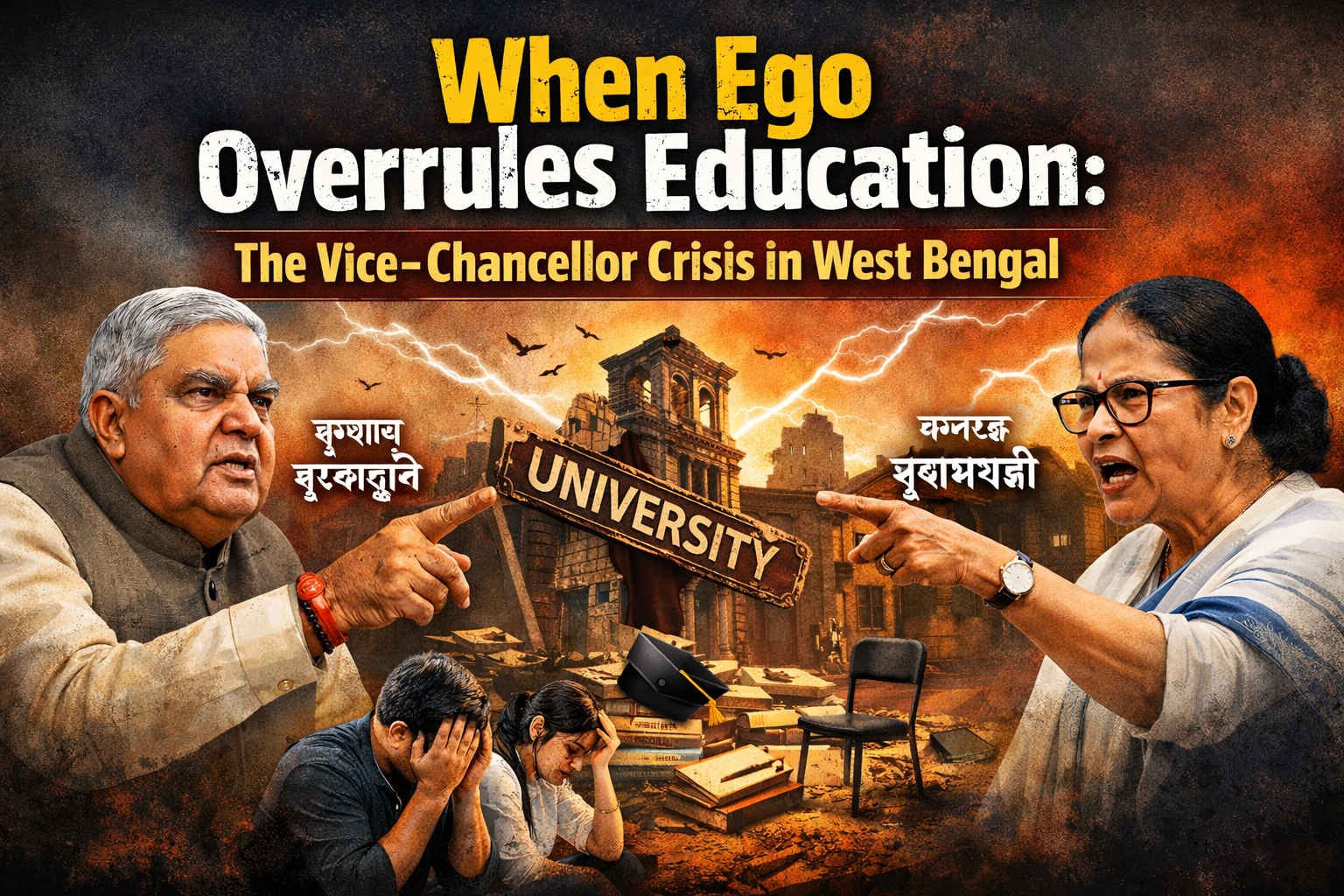
A distinctly Machiavellian logic appears to govern university administration in West Bengal, where the state’s two constitutional authorities—the Governor and the Chief Minister—have been locked in a protracted struggle to outmanoeuvre each other over the appointment of Vice-Chancellors (VCs). What ought to have remained a limited constitutional disagreement has instead spiralled into an acrimonious political confrontation, marked by mutual distrust and institutional brinkmanship.
The Governor has consistently justified his actions by invoking his constitutional authority as Chancellor of state universities, while the state cabinet has countered that the Governor lacks a popular mandate to exercise such powers unilaterally. This conflict reached an especially troubling pitch when the present Chief Minister publicly challenged a former Governor to contest an election before asserting authority over VC appointments—an episode that starkly revealed the erosion of constitutional propriety on both sides.
Since the tenure of Jagdeep Dhankhar as Chancellor, and over the past four years in particular, the standoff has degenerated into an intense political acrimony and psychological battle. What began as a dispute over constitutional interpretation has turned bitter, personalised, and ultimately scandalous, undermining the credibility of the offices involved. The resulting administrative paralysis has had serious repercussion for universities, affecting students, teachers, and researchers alike.
Deadlock at levels
The deadlock grew so severe that the matter was eventually referred to the Supreme Court of India, ostensibly to safeguard the functioning of higher education institutions and protect the interests of the academic community. The episode stands as a cruel tale of how constitutional ambiguity, when compounded by political rivalry, can corrode institutional governance and weaken democratic norms and takes heavy toll of academia.
Vanishing administration in the university.
Yet allowing the situation to reach the apex court is itself a damning indictment of governance. Despite judicial intervention, students—both undergraduate and postgraduate—remain the worst sufferers. Confusion has gripped academic and administrative machinery alike, with no resolution in sight. Students and researchers are anguished to witness their once-cherished centres of higher learning remaining “topless” for months, even years and reduced to something unexplainable.
Leadership is universally recognised as essential. Every institution—government offices, private establishments, schools, police stations, even local clubs—functions under a designated head, ensuring authority, dignity, and accountability. That universities, the highest centres of learning, should function without leadership is unthinkable in any civilised society. Yet this is the stark reality in West Bengal today. Paradoxically, while Public Administration occupies a pivotal place in university syllabi, state universities themselves resemble rudderless boats, adrift without any meaningful administration and if there is no administration in the university itself, what the rest of the society would learn from it. Some two years back one girl student was openly stabbed in her mathematics class room in Gaur Banga University. Still it is no eye opener for the rulers in our state!
The feud between the two constitutional authorities has become so entrenched that universities continue to function brazenly without Vice-Chancellors, with little sense of shame or accountability within the state cabinet. Even the Supreme Court’s intervention has failed to restore normalcy or discipline. The cold war persists, while students pay the heaviest price—their futures suspended in uncertainty, with no visible light at the end of the tunnel.
This leadership crisis coincides with a broader gloom engulfing higher education across the state. Students are increasingly disenchanted developed a revulsion with formal education. News papers are replete with features indicating a serious down slide to our education. In the 2025–26 academic session, only 2.34 lakh students enrolled in colleges and universities, while nearly 7 lakh seats remained vacant. Large-scale migration of students mid-session has become common, driven by uninspiring curricula, administrative chaos, and bleak academic prospects. Severe economic compulsions push many students into premature employment, hollowing out undergraduate classrooms. In this current session , the successful candidates in HS Examination , could not be admitted into college after the lapse of eight months because of OBC cases remained pending in the Supreme Court. Thousands and thousands of student left this state for pursuing higher studies and a majority preferred for private universities.
Dropouts are not confined to higher education alone. In 2023, nearly 8 lakh students were missing from the Madhyamik (secondary school-leaving) examination. Around 8,000 high schools now stand on the verge of closure due to the absence of students or teachers. Crumbling infrastructure has turned many educational institutions into virtual ghost houses. Yet the state government remains disturbingly unperturbed. No serious policy initiative or intellectual engagement appears to have emerged from the Education Department to reverse this alarming decline.
Nonexistent higher education dept
The Higher Education Minister’s presence is felt not through reform or vision, but through public tirades against the Governor, who is also the Chancellor of state universities. His conduct—mocking the Governor’s appearance, attire, skin colour, or spectacles—reflects an alarming lack of decorum and decency. Such vulgarity inevitably percolates down the administrative hierarchy, paralysing universities and eroding institutional dignity with no end.
Instead of addressing the declining quality of education and research, the minister prefers to hurl abuse at the Governor and Vice-Chancellors appointed without the Chief Minister’s consent. Women Vice-Chancellors, notably Professor Santa Dutta, of Calcutta University bore the brunt of this hostility. He repeatedly referred to her as a “temporary” or “makeshift” VC, deliberately undermining her authority by publicly suggesting her tenure was fleeting and thereby inconsequential. What more calumny can be heaped if any VC continues to listen about her ephemeral tenure from education minister of the state ?
The consequences for higher education have been devastating. Lower postgraduate intake, combined with administrative paralysis, has crippled research activity. Financial sanction and concurrence from the Vice-Chancellor and Registrar are prerequisites for research programmes and UGC grants. Without a functional administrative structure, research funding remains elusive, further eroding academic standards.
Limited fall out because of SC’s intervention
In an attempt to break the impasse, the Supreme Court constituted a Search and Selection Committee under the chairmanship of former Chief Justice U. U. Lalit. The committee’s mandate was to recommend names acceptable to both the Chief Minister and the Governor. Out of 36 state universities, only 19 received unanimously agreed-upon Vice-Chancellors. Seventeen universities—including premier institutions such as the University of Calcutta, Jadavpur University, and Rabindra Bharati University—continued without Vice-Chancellors for a prolonged period. Even now, six universities remain headless. Over the past fifteen years, Gaur Banga University has witnessed the tragic removal of as many as seventeen Vice-Chancellors, if not more. To this day, the university has neither a permanent Registrar nor a permanent Controller of Examinations, as top political authorities have failed to reach a consensus on compromise candidates amid intense factional rivalries.Among these, North Bengal University and Thakur Panchanan Barma University in Cooch Behar deserve special mention. Despite being a UGC-recognised institution, North Bengal University remains deprived of key administrative posts—Registrar, Controller of Examinations, Finance Officer, and others. The situation is aggravated by recurrent violent demonstrations by non-teaching staff, who exploit the vacuum of authority. One former Vice-Chancellor, appointed by the Chancellor, was denied remuneration and effectively forced out of campus. At Rabindra Bharati University, even a former High Court judge appointed as VC was heckled and humiliated by non-teaching employees.
As per established procedure, the Education Department is required to forward a panel of three names for each university, from which the appointing authority makes a final selection. This mechanism, too, has been rendered dysfunctional by the ongoing deadlock, prolonging institutional paralysis and deepening the crisis in higher education. West Bengal’s universities today stand as tragic monuments to administrative ego clashes, political vendetta, and systemic apathy. Until constitutional responsibility supersedes personal animosity, the future of higher education—and of an entire generation of students—will remain hostage to this shameful stalemate.