







Santanu Basu
Santanu Basu is Former Professor of Political Science, Chanchal College, Malda
Connect: santanub12@rediffmail.com
An endless conflict continues between humans and elephants across the Dooars region, encompassing tea gardens, agricultural lands, and the adjoining localities of Alipurduar and Jalpaiguri districts in North Bengal. In this deeply unequal struggle, elephants often outmanoeuvre and overpower the most vulnerable—poor men and women, tea garden labourers, and marginal farmers who have little means to protect themselves.
As elephant attacks increase across several tea gardens, survivors are often left running from place to place in search of monetary relief, even to perform the last rites of the deceased. Many tea gardens that are closed or defunct fail to provide even minimal assistance to bereaved families. For those left behind, life appears bleak, with little support and no clear hope for the future.
There is wider unanimity among the environmentalist that driven by hunger and shrinking habitats, elephants frequently raid into forest-edge settlements, where vulnerable residents become victims of sudden and violent encounters but such raids are frequently countered by man in another crueller form. In several incidents in dooars , elephants violently lifted people with their trunks and threw them against trees, poles, or buildings that result in reducing into bloody lump. Such attacks, especially during the dead of night amid severe winter cold, leaving victims little chance to escape or seek help. Repeated incidents of trampling have claimed many lives, turning forest fringes and village outskirts into zones of fear , loss and trepidation for those who depend on these areas for survival. People of Bankura district in western part of West Bengal , still remember of one wild tusker rampaging and smashing a man whom climbed on a tree of 15/18 meters height , while the angry elephant stopped at the base of the tree and trembled it ; the tree along with the passerby collapsed and the elephant swiped and smashed the man within no time. The cruelty of elephant is endless and the story revolves.
During the bitter cold at the end of December, impoverished labourers generally, after back breaking labour , bolt their doors from inside and huddle under ragged quilts or thin blankets, for just sleep shivering through the freezing nights, but alas! These harsh cold nights, coinciding with Christmas, offer little peace both from nature and marauding elephants.
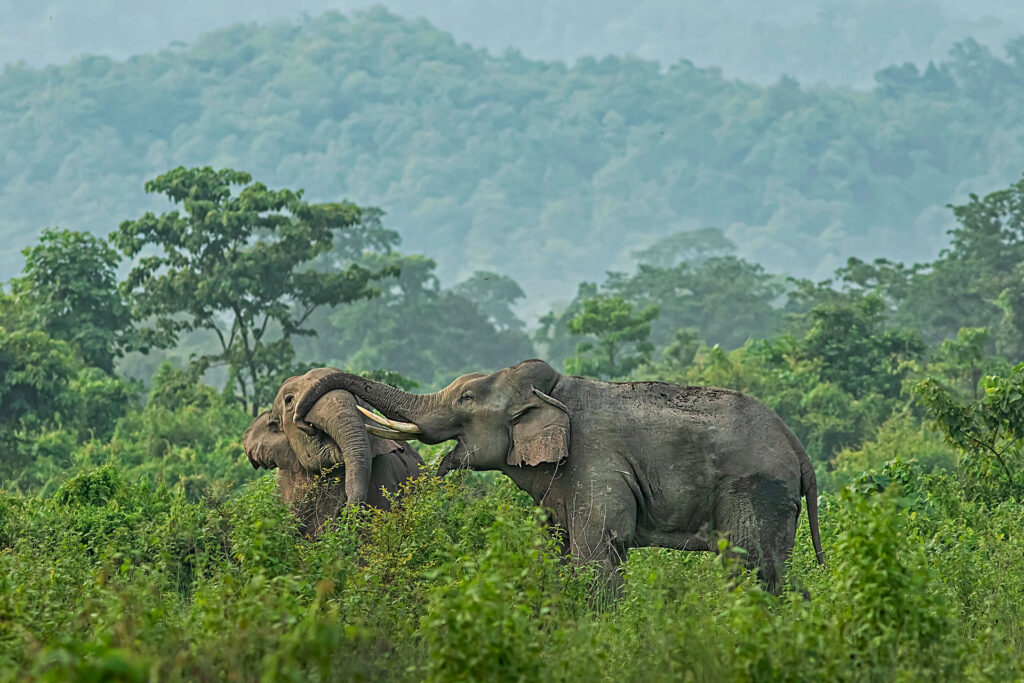
Environmentalists and newspersons think that it is reprisals on the part of elephants who have lost forests, fodder and corridor who driven by sheer hunger and rage after losing their habitats and traditional corridors to human expansion and intrude into fragile, thatched hamlets of tea garden workers and daily wage earners and on agricultural lands . Homes are crushed, lives are lost, and lands are ransacked , crops and potato fields are destroyed years after year and fear spreads through the darkness as a result of tromping . Before people can understand what is happening or find a way to escape, the elephants strike—leaving behind death, devastation, and trauma. Lives, wealth, crops are at the mercy of elephants in Dooars and Bankura districts.
The nights on the eve and during Christmas were especially terrifying and chilling . For many tea garden labourers, Christmas night became a time of shock and mourning instead of joy and festivals: The celebration and festivities turn into horror and many families experienced loss and grief of the loved ones were killed in Christianity dominated villages. For survivors, the winter cold is matched only by the constant anxiety of elephant incursions. The horror seems never-ending, leaving survivors to wonder which is more dreadful—the biting winter cold or the terror that arrives silently in the night ransacking the doors. The carol and the Church bell are now symbol of mourning in memory of the deceased in the tea gardens’ labour lines and colonies.
In the dead of night on Christmas Eve, Sandhaya Bibi (63) was killed in an elephant attack while collecting firewood in the Changmari beat of Kumargram. The elephant trampled her, and her body was later sent for post-mortem examination. In another incident the same night, a man named Pabitra was reportedly lifted by an elephant and killed with cruelty .
In Bankkandi village under East Jateshwar Gram Panchayat, Roy (55) lost his life in a tragic way. After that attack, the elephant moved on to Dhulagaon village, where a woman named Juthika Roy was dragged for a considerable distance before being killed. Officials of the forest department confirmed that repeated warnings had been issued to villagers not to venture into forest areas, but these advisories were often ignored due to livelihood needs. Bhalka Range Officer Pravat Kumar Barman stated that people frequently enter forest zones despite the risks. It is reported that elephants raided and damaged multiple houses, as well as paddy and potato fields, on its way in Gadong, Dangapara, Malsagaon, and Guabarnagore under Jateshwar-I in Dhupguri. The attacks left several families devastated. Suchitra , the widow of Pabitra; Jaba Barman, mother of Juthika; and Nurul Mian, relative of Sandhaya Bibi, continue to mourn their loved ones, struggling to find justice or support in the aftermath of these tragic incidents but possibly with no relief . However, some residents narrowly escaped death. Ajijen Necha, along with Reshmi Parvin (18) and Rahem Haq, survived an elephant raid on the same night in Pradhanpara village under Shalkumar-I Gram Panchayat in Alipurduar-I block. When elephants entered their house in search of stored paddy and rice, the occupants managed to escape by jumping out through a window.
Pradhanpara and the neighbouring Munshipara village fall under the Jaldhara West range and lie within a known elephant corridor close to the Jaldhaka and Torsha rivers. Survivors later recounted the terror of waking up suddenly in the freezing cold to find elephants inside their homes.
In Munshipara village, two elephants broke into the house of Sachindra Roy, damaging the kitchen walls and consuming stored rice, pulses, and vegetables. Another resident, Anil Adhikari, also fled his home as elephants entered and destroyed food supplies. In most cases, the pattern of attacks shows that elephants target kitchens and stored food, and elsewhere primary schools for devouring mid day meals highlighting severe food scarcity among the animals. Forest officials acknowledge that parts of North Bengal are currently facing a serious shortage of natural fodder, worsening the human–elephant conflict.
Shukra Kharia (47) went for grass and firewoods in Radharani Tea garden adjacent to Buxa Tigher Reserve in Kalchini block , another elephant corridor zone when she was trampled by an elephant and was smashed to death. Shukra’s son later disclosed that his mother was a regular collector of firewood for cooking but her death was unimaginable. Shukra, a collector of firewood for cooking, lost her life in circumstances described as unimaginable. The Deputy Field Director of Buxa Tiger Project, Harikishen PJ, stated that her body was found several metres inside the core area of Buxa Tiger Reserve, a zone with heavy restrictions. As a result, her family is likely to be denied to claim any compensation, adds to the tragedy of the loss.
But the death of Shukra is reminiscent of tragic death of three persons , namely Chandmuni Oraon, Shukurmani Lohar and Rekha Barman exactly one year back on 12 December, 2024 ie on the eve of Christmass , who entered into Mendabari Jaldapara National Park for grass and fodder. Incidentally , areas surrounding the National Park is replete with hundreds of resorts, pubs, hotels, parlours , even bars and shops causing a direct blow to the ecology of this important biosphere.
On 22 August, 2022, a body of full grown tusker was detected detected dead in Santali Mandalpara under Kalchini block of Alipurduar district. The trunk of the elephant got intertwined or entangled with the electric blade wire put up for driving away the herds intending to destroy the winter crops. Such devious practice of erecting electric barbed wire was vehemently restricted by the forest authorities , but damn care triggering man and elephant fight at ‘ground zero’ . The village is located in the middle of Jaldapara National Park and Buxa Tiger Reserve , the two important biosphere of North Bengal forestry. In the recent past , Justice Biswajit Basu of Calcutta High Court castigated West Bengal government vehemently for not dismantling the illegal resorts sprouted in the core areas of Buxa Tiger Reserve. Amid the death of both man and elephant remaining unabated , Next in 29 August , 2022 another full grown elephant was found dead adjacent to Raimatang tea garden under Kalchini Block ; the forest officials disclosed that the death might have occurred due to fight between the two elephants. Quite recently , on 31 August (2025) another full grown elephant was found electrocuted in Vijayapur bustee in Acchapur division of Bhatpara tea garden under Kalchini block 1 . Again , three years back , on 22 September , 2022 this area witnessed death of a female elephant and in similar electrocution situation ; the accused dug up another big trench to hush up the carcass. But before he perpetrated the horrendous crime, forest officials nabbed the culprit.
The underlying issue is a shortage of fodder across many reserved forest areas, particularly in Jaldapara National Park and the catchment areas of the Torsha , Jaldhaka and myriad rivers making an ideal habitat for elephant to rhinos, bisons , barking deer etc. Over the years, these river systems—stretching for nearly 40 kilometers , and unique grasslands covering three hundred hectares inside the JNP —have sustained wildlife by providing grasses, shrubs, and other vegetation down the ages. This ecological richness, climate , particularly the rainfall and moisture over and above diversity is a key reason the region has become a major and biodiversity hotspot in the country. But the devastating flood that wreaked havoc in North Bengal at the end of October that submerged and destroyed the grass land considerably and the vast stretch of river banks was overshadowed by flood sediments ; The effects of this destruction are still being felt , as there is now scarcely any grass remaining in the catchment areas of the Jaldhaka River. Elephants have been pushed to the margins of their habitat. Over the past decade, the West Bengal government has not undertaken any major initiatives to significantly augment fodder resources in the forests of North Bengal. It is also seen that North Bengal experiences very erratic or lower rainfall due to global warming that hinders the growth of shrubs and bushes. The fodder shortage which is chronic in North Bengal forestry make both the elephants and man are at war path.
It is hard to believe that the elephants , apart from smashing , killing, tromping the fields resort very bizarre ( which may be termed as outlandish or grotesque or for that matter totally crazy) ways to feed their selves and by default teaching a good lesson to man. In Mahananda Wild Life Sanctuary , where numbers of camps have set up by the forest dept for keeping vigilance upon the straying elephants. On one occasion the forest watchmen observed an elephant was moving away from the camp’s kitchen carrying a pressure cooker in its trunk. The watchmen rushed behind the elephant to retrieve the pressure cooker , but before it left , it crushed the pressure cooker fully.
In another incident , in Shalkumar hat under Falakata block 1, an elephant was seen after invading a house of a poor woman in night consumed the mosquito net after tearing while the sleeping women was trembling with fear and jumped from her house. The bizarre stories are long and the forest officials are preoccupied demarcating whether the trampling or damage took place with the core areas or outside as this classification affects the eligibility for compensation to the affected residents or seen engaged in sending the bludgeoned body for post mortem and subsequent compensation ; The story goes on. Despite the circle of violence with no sign of relenting from both sides , the moneyed people , the rich and the vulgar elements in society remain unperturbed and fulfil their coffers they go wanton in anti wildlife activities in connivance with forest officials , Land Reforms officials or Panchayati functionaries. It is clear that the state agencies are hand in glove with the mafias intending to ruin the forests and corridors of elephants. The collusion with state government officials are so deep rooted that the vulgar rich often tear the forest acts to set up factories , stone crushing units , sand mining units in the core areas of the forests or upon known elephant corridors.
In Madarihat under Khairbari Gram Panchayat , One Avinav Gandhi has dared to construct a three storied bought leaf factory after occupying 350 sq. Metres or of land upon known elephant corridor while the forest officials including Parvin Kashwan , the DFO , looks other ways. The local residents are already rattled by the rumbling of heated boilers and machines are unable to sleep and fall sick. The local residents and of course, the wild lives libing nearby habitats are affected equally by the blaring of factory and the locals submitted deputation against sound pollution and for encroachment of forest lands comprising elephant corridor. It is also reported that that the residents bearing the brunt of cracking of the factory also have cancer patient in their hutments!
Parvin Kaswan , the DFO said certainly Avinava Gandhi might have procured the No Objection Certificate from somewhere . The DFO prevaricates when asked how the NOC was issued since she is the sole authority of issuing NoC to factories coming up in the protected areas? Such is the rot and muck in the forest dept. plagued with serious illegality. The Panchayat member , Rakhi Sing said that she had not issued any trade license to Avinava Gandhi for bought leaf factory ; so it’s a matter of great mystery , how a large factory can spring up on elephant corridor nearer to JNP without any trade license or NOC supposed to be issued by the DFO? No Answer. The sufferers , the sick , the aged people adjacent to Bought leaf factory believe this encroachment may be contributing to increased incidents of elephant straying and crop or property damage . Such crass , gross and illegal activities of hitting the wild lives by the forest dept. itself , can well explain the reasons of straying and raiding the elephants into localities smashing and killing the poorer garden labourers or marginalised man living at the margins of forests.
In Lataguri adjacent to Garumara National Park , surprisingly , a large swimming pool is being constructed by the resort owner along Malbazar–Lataguri NH 717 to the detriment of interests of the elephants and rhinos using the known corridor . It is unimaginable that the construction of swimming pool and a boundary wall in known elephant corridor is possible without direct patronage of the officials and bureaucrats having scant regard for forest laws? Do the forest officers have not any precedent of elephants falling into large sized ponds surrounding the arms and ammunition rooms in Bengdubi army cantonment in Bagdogra under Kurseong forest division? Still such suicidal efforts of creating a swimming pool inside Lataguri forest throwing away every norms and rules supposed to protect wildlives ? Is the dooars forestry in North Bengal is up for sale?
I wonder with the prevailing paradoxes – the IFS ranked officers in connivance with top political hierarchy dilute and sabotage the forest rules with impunity for huge gratifications , but on different occasions , they appear as a saviour before the grief stricken poorer people who have just lost their loved ones because of trampling of elephants in the houses in the forests. But it is this high officials who fix the compensation from public exchequer .