







India strongly rebuffed the United States’ imposition of a punitive 50 percent tariff on Indian goods by accelerating a comprehensive trade agreement with the European Union. The agreement was concluded through high-level engagement between Prime Minister Narendra Modi, European Council President António Costa, and European Commission President Ursula von der Leyen. This strategic move effectively countered mounting U.S. pressure linked to India’s continued purchase of Russian crude oil.
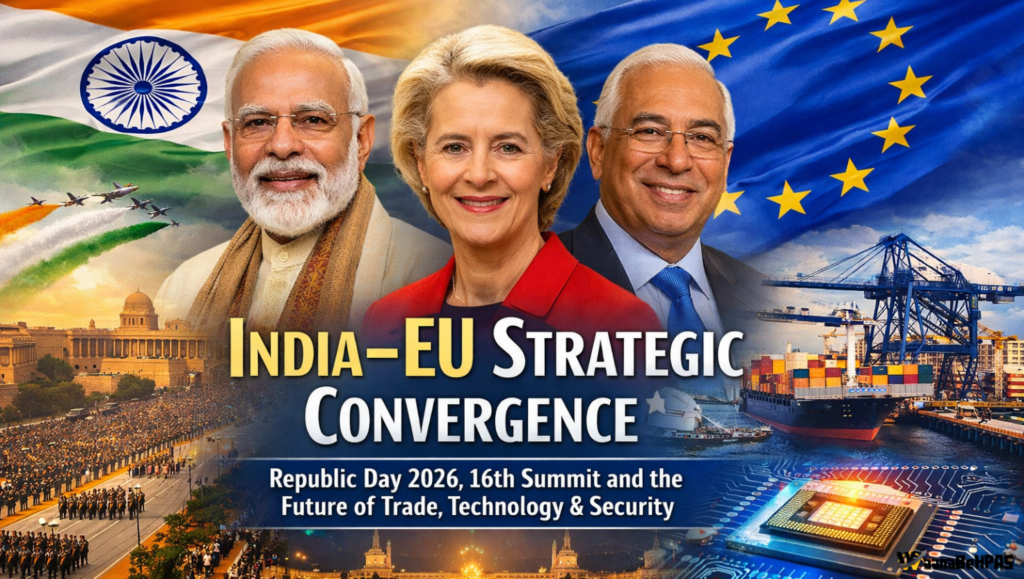
The Trump administration justified its tariff escalation by citing India’s energy trade with Russia, alongside sweeping economic sanctions on major Russian oil producers such as Lukoil and Rosneft. India initially mitigated the impact by diversifying its oil sourcing across global markets and subsequently consolidated its position through the India–EU trade agreement—widely described by commentators as one of the most consequential trade deals of the decade.
The agreement lays the foundation for a broad economic corridor linking India with the European Union’s 27 member states, integrating markets representing nearly two billion people. Negotiations, which began in 2022 and experienced intermittent pauses, have now reached completion and await ratification by the respective legislatures. Implementation is projected for 2027. Analysts estimate that the agreement could progressively influence nearly 25 percent of the combined GDP of India and the EU.Under the agreement, India is expected to gain expanded tariff-free access for exports such as textiles, leather goods, footwear, tea, coffee, spices, and jewellery—one of the treaty’s most economically significant outcomes. In return, European manufacturers, particularly in the automobile sector, are expected to gain improved market access in India at more competitive price points. European consumer goods—including wine, chocolate, and processed foods—are also set to benefit.
The deal reportedly provoked strong reactions in Washington. U.S. Treasury Secretary Scott Bessent publicly criticized the agreement, reflecting broader unease within the U.S. administration. Observers argue that the deal undermines long-standing American efforts to maintain post–World War II economic and strategic dominance. Trump’s confrontational trade posture, combined with threats of tariffs and coercive diplomacy—including controversial remarks concerning Greenland—has further alienated traditional allies and accelerated counter-balancing efforts, particularly within Europe.
Despite these tensions, India has maintained stable diplomatic relations with the United States while preserving its strategic partnership with Russia. Between August and November, India continued purchasing Russian oil despite aggressive tariff threats, yet refrained from endorsing or supporting U.S. coercive actions against third countries. This calibrated diplomacy has allowed India to expand its strategic autonomy.
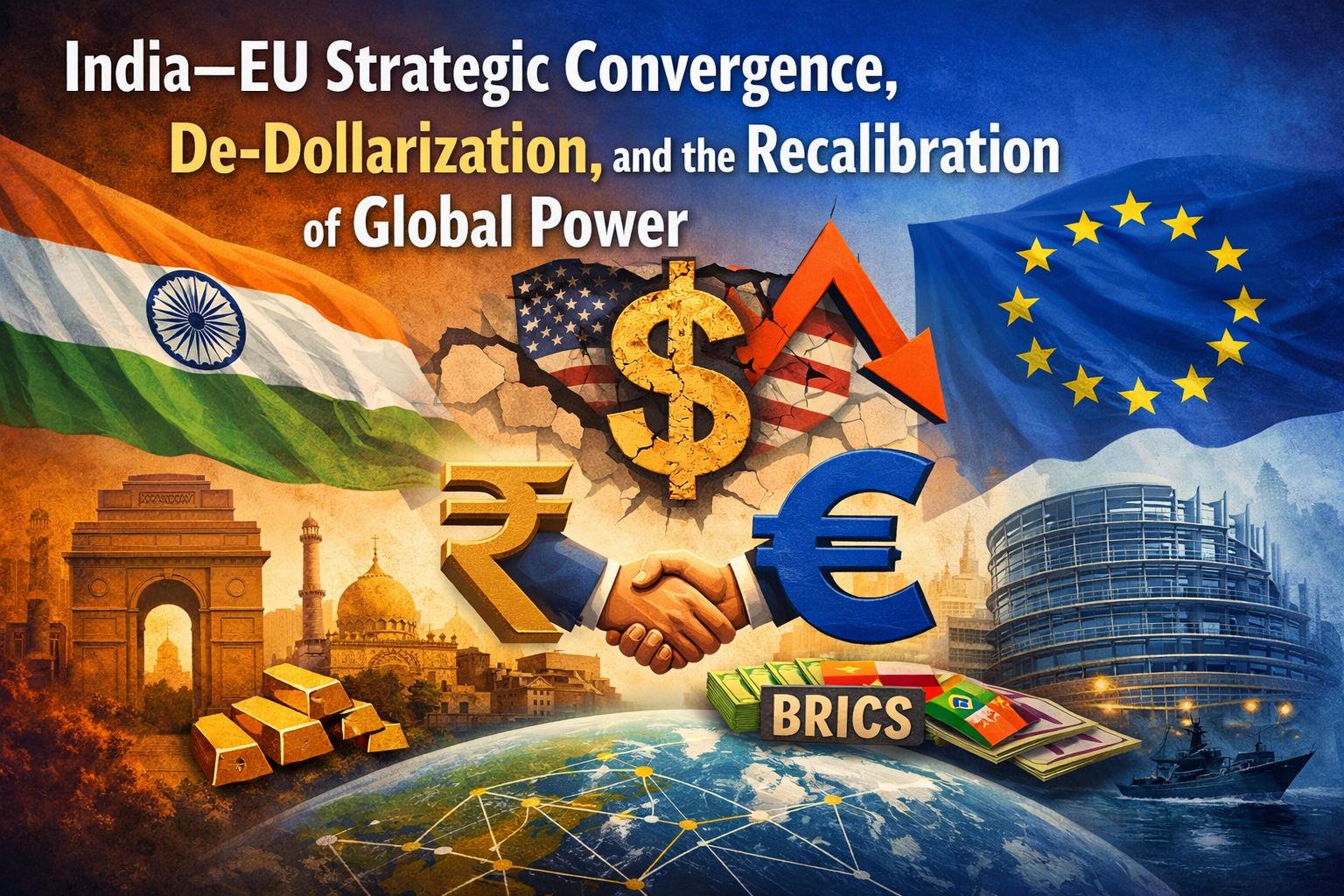
In this context, the growing convergence between India and the EU represents more than a trade arrangement; it signals a structural challenge to the unilateral dominance of the U.S. dollar. Since the end of World War II, the dollar has functioned as a central instrument of global economic influence, largely because international trade, energy markets, and military expenditures have been denominated in dollars.
Initially anchored to gold, the dollar’s global role was formalized by the 1944 Bretton Woods Agreement, which replaced the British pound sterling as the world’s primary reserve currency. At the time, the United States controlled nearly two-thirds of global monetary gold. Although the gold standard ended with the 1971 “Nixon Shock,” the dollar retained its dominance through the establishment of the petrodollar system in the mid-1970s, under which oil exports—particularly from the Gulf—were priced in dollars.
Today, that dominance is increasingly questioned. De-dollarization—defined as a gradual reduction in the use of the U.S. dollar in global trade and finance—has become a serious topic of discussion among investors, corporations, and policymakers. While the dollar still accounts for slightly over 60 percent of global trade settlements, the euro holds roughly 20 percent, with scope for expansion.
Western analysts argue that the EU, responding to Trump-era unilateralism, is deliberately working to elevate the euro’s international role. The India–EU trade agreement fits squarely within this strategy. Under evolving trade understandings, EU member states are expected to purchase petroleum products refined in India, potentially settled in euros. This development, combined with the India–Middle East–Europe Economic Corridor (IMEEC), could significantly weaken the structural foundations of the petrodollar system.
In 2023, Germany, France, Italy, and other G-20 countries endorsed the IMEEC framework, linking Gulf economies with Europe through India. This corridor creates opportunities for deeper financial integration between the euro and energy-rich Gulf states. Should oil transactions increasingly shift to euro settlement, the global relevance of the petrodollar would erode, prompting many countries to reassess their U.S. dollar reserves. India is widely viewed as a leading participant in this transition. Parallel discussions on strengthening links between gold and major currencies—particularly the euro—further reinforce this trend.
Meanwhile, the United States faces mounting internal economic pressures. Persistent fiscal deficits have compelled the U.S. government to rely heavily on foreign borrowing through Treasury issuance. The European Union remains one of the largest holders of U.S. Treasury securities. Any coordinated reduction in these holdings could destabilize U.S. financial markets.
Global investors currently hold an estimated $69 trillion in U.S. assets, or roughly $27 trillion net of American investments abroad. European investors alone hold about $2 trillion in U.S. Treasuries, while countries such as Norway, Canada, Denmark, and Switzerland maintain substantial exposure to U.S. equities and debt. As geopolitical uncertainty intensifies, these investors may increasingly rebalance their portfolios.
Recent currency movements underscore this vulnerability. The dollar has weakened against the euro and the pound, while the Swiss franc surged following portfolio shifts. Notably, a Swedish pension fund reportedly sold $8.8 billion worth of U.S. Treasury bonds, triggering sharp market reactions. Analysts caution that this may represent the early stages of a broader sell-off, particularly if tariff threats and retaliatory trade measures continue.
Taken together, the India–EU strategic alignment, evolving energy trade mechanisms, and rising investor caution signal a gradual but meaningful reconfiguration of the global economic order—one that challenges the long-standing primacy of the U.S. dollar and constrains the effectiveness of unilateral economic coercion.
Santanu Basu,Ex professor,
Chanchal College