







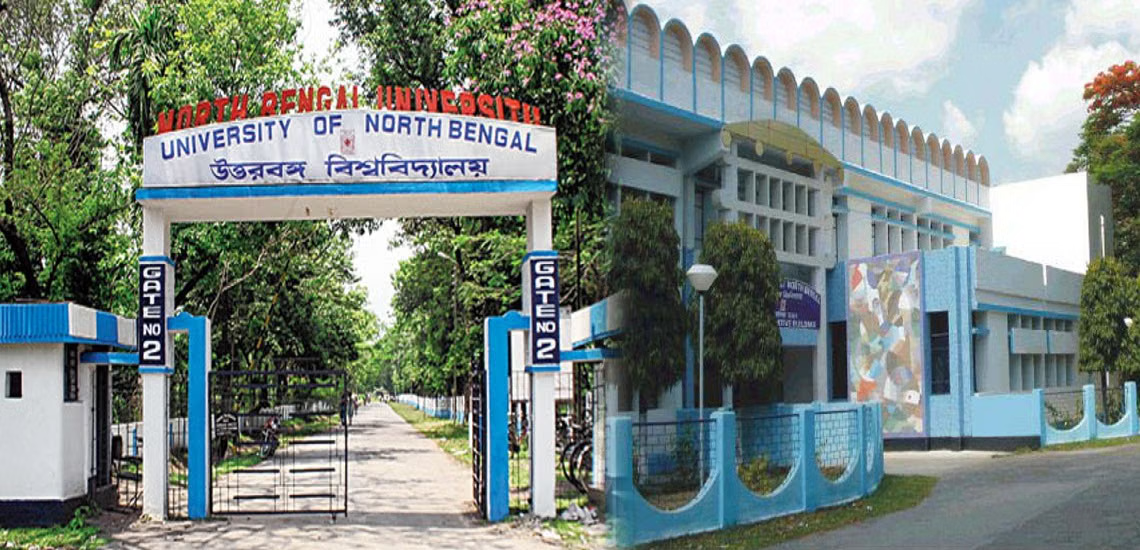
Once hailed as a cradle of higher education and research in northern West Bengal, the University of North Bengal (NBU) now stands at a perilous crossroads. Once known for its academic rigor and robust research output, the institution is reeling from years of administrative decay, political interference, and factional infighting. The very foundation of the university — both academic and administrative — appears deeply shaken, if not irreparably fractured.
The question being increasingly asked is: Are North Bengal University’s days numbered ? Alumni of this great institute can hear alarm bell that has already been rung considering the ever lowest educational activity currently. The affiliated colleges of this university are worst affected because of zero educational programme with rampant mass copying at the under graduate level. Lumpenraj at its highest point now.
Established in 1962 with the aim of extending quality higher education to the largely underserved regions of North Bengal, the university grew significantly under the ‘shadow’ of Raja Rammohun Roy , Thakur Ramkrishna , Swami Vivekananda and Sister Nivedita ( the University is named after Raja Rammohun Roy and different buildings are ingrained with the name of greatest personalities) , in the decades that followed — particularly during the 1980s and 1990s — becoming a beacon of research and learning. But the last three years have seen a precipitous decline.
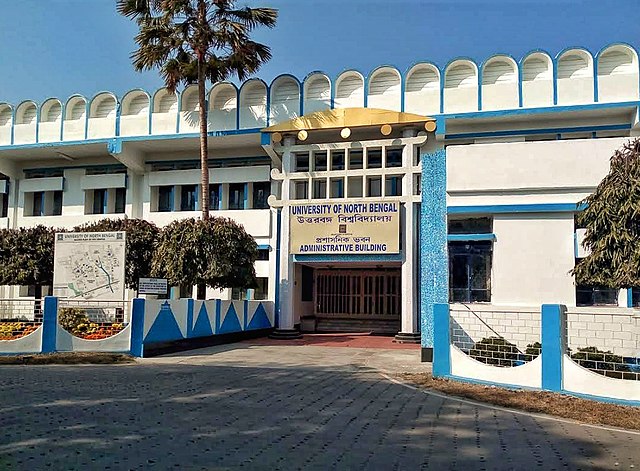
What was once a reputed institution with a functioning academic and research ecosystem has now become, according to insiders and academics, a fiefdom of politically protected miscreants, party loyalists, and administrative apathy. For years, crucial administrative posts — Registrar, Controller of Examinations, Finance Officer, Estate Officer, Inspector of Colleges, among others — have remained vacant or under makeshift arrangements, resulting in a complete collapse of governance.
Currently, there is no functional administrative hierarchy. As one academic bluntly put it, “To say the administration has collapsed would be generous — there is no semblance of one.”
The seeds of institutional decay were sown as early as 2005, when the Registrar, was accused of financial irregularities ( rightly or wrongly) and faced an FIR lodged at Matigara Police Station. Despite the serious nature of the charges, the registrar enjoyed political protection from the then-ruling CPI(M) in Darjeeling district. What followed was a prolonged legal tug-of-war, with Sarkar ultimately getting reinstated by the Supreme Court after five to six years of litigation.
During that period, the Registrar’s room was locked by the Vice Chancellor — and, shockingly, it remains under lock and key even today, nearly two decades later. Despite regime changes and various interim measures, no statutory or governmental mechanism has been implemented to resolve this longstanding paralysis, a symbolic reflection of the university’s institutional stagnation. Notwithstanding the fact that the Registrar was reinstated and worked at short stint , but the magnanimity of the glory of both the post of Registrar and University were smeared beyond redemption. And that glory was never restored ; the intense suffering of the university remained unabated since then.
It is a matter of great sorrow that blinded by power aiming to devour more and more administrative power and totally sunk into game these important most functionaries of university are oblivious of the fact that , in reality they act as a pawn in the hands of politicians and ministers, or they serve the politician instead of serving the students and researchers. They are forgetful of a great dictum of Christianity , render thou into Jesus what is for Jesus , and Church what is for the church. The dangerous cocktail between power centric politics with the administrative structure of a university , result to create such unfathomable anarchy , deeper animosity among the teaching fraternity , that it can never be retrieved. This particular university is immersed into morass of quagmire.
Equally shocking is the scenario prevalent in Gaur Banga University which was built up some twenty years back to lessen the administrative burden of NBU. Alas, the pervasive infection of NBU steadily contaminated the GBU and the intense lobbyism within the CPI(M) damaged the administration no sooner than it started its journey. The post of Registrar is again subjected to intense bargaining between the then CPI(M) Birbhum district Committee and Malda Committee resulting a stalemate which never resolved during the last 16 years and none could join in that gubernatorial post till today, stalemate of the past continued today . Some one is picked up as asked for continuing in the vacant position till the next ad hoc man is found out. During the last one and half decade , on an average 8 to 10 ad hoc man was made shuttling from one post to another ruining both the administrative structure and academic ambience.
Since the early 2000s, political factions — initially within the CPI(M) and later within the Trinamool Congress — have treated the university as a battleground. Internal feuds, muscle-flexing, and partisan appointments have pushed the university into a vortex of dysfunction. ‘One factions’ Registrar ,or Inspector of Colleges , after appointment , face sabotage or subterfuge by counter factions resulting demoralisation of the incumbent. This is the crux of the crisis spread like contagious disease.
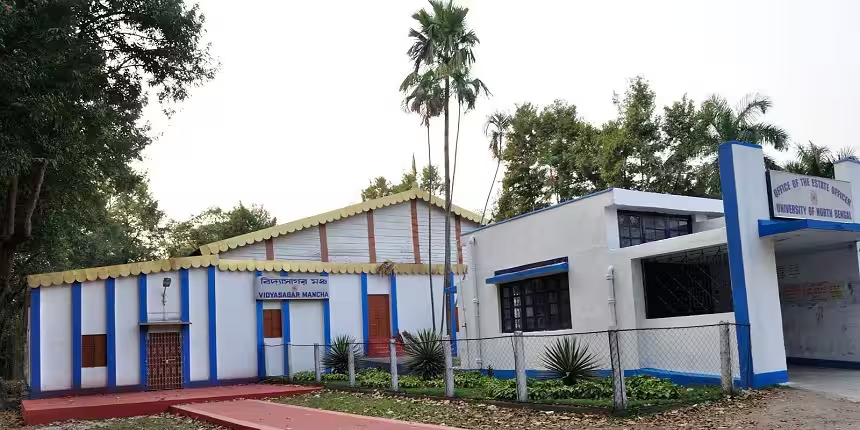
Successive Vice Chancellors have faced harassment, obstruction, and in some cases, open threats. Faculty appointments, non-teaching recruitments, and research funding allocations have all been marred by nepotism and backdoor lobbying. University statutes and UGC guidelines are frequently sidestepped in favor of appeasing local political satraps and their supporters.
Even academic councils and examination boards, once sacrosanct spaces for deliberation, have been reduced to rubber-stamp bodies amid growing intimidation from student wings and local syndicates. In majority cases , such bodies are non existent . Intriguingly , non teaching staff comprising mainly the outsider hit the VC or registrar ( although ad hoc) like anything, Hurling abusive languages or choicest expletives , privy of them, to the VC or Registrar have darkened the situation. Gheraoing them over night with verbal abuses compel the functionaries to relinquish the ad hoc posts even. There is wide vacuum in the University largely because of hooliganism of the non teaching staff demanding higher pay scale, perks and staff quarters inside the campus although they initially agreed to work as a purely temporary staff and stop gap arrangement with lump sum honorarium set aside any pay scale. But once their entry into the administrative building is ensured , they cry hoarse for permanent job and staff quarter causing huge doldrums into the campus. Majority of the universities suffer from this malaise as this sort of staff are the convenient tools of the politicians who act as instrument in assembly or Lok Sabha polls.
Research activity — once a hallmark of NBU — has nearly ground to a halt. Frustrated by bureaucratic delays, funding bottlenecks, and a hostile campus environment, many scholars have either left mid-way or refrained from enrolling altogether. The impact on students is no less severe: regular classes are disrupted, examinations delayed, and administrative services — from transcripts to degree processing — are erratic at best. Things arose to such a level that a proper PG Examination programme could not be announced in due time. Science practical examination could not be announced due to disruptive movement of the ad hoc staff. And the lumpen elements in students community held the Examination system into ransom ; they also demanded that all students be declared pass. Lumpens have a hey day in this university.
One faculty member described the situation as “academic depression.” The morale among students, researchers, and faculty is at an all-time low.
The final blow, many say, came with the 2022–2023 controversy surrounding Subiresh Bhattacharya, then serving as Vice Chancellor of NBU and also holding a controversial position in the West Bengal School Service Commission. His arrest by central agencies in a recruitment scam sent shockwaves through the academic community and across the state. People observed with great disdain the extent of rot pervaded and perforated into the head of such unique institution. The scandal not only exposed deep-rooted corruption in the state’s education system but also ignited a fierce turf war between the Raj Bhavan and the state education department.
This incident catalyzed an already ongoing administrative freeze, with the Governor and State Cabinet locked in a power struggle over appointments, policy decisions, and university autonomy. Earlier the internal feuds in CPI(M) stirred the University , now the street level brawl between state Governor and Chief minister vitiated the campus so much so that the contention spilled into Supreme Court. The judicial team led by honourable Justice Udaya Bhanu Lalit intervened time and again to resolve the stalemate persisting in the university.
Despite repeated appeals, neither the West Bengal education department nor the University Grants Commission (UGC) has taken concrete steps to stabilize the institution. The crisis at NBU is no longer a local issue — it represents a microcosm of the larger rot afflicting many public universities in India, especially in politically volatile states.
For the university to survive — let alone thrive — an immediate, high-level intervention is needed or Universities be closed altogether. The state government must depoliticize university governance. The UGC must step in to enforce academic standards. And most importantly, there must be accountability for those who have hijacked a once-proud institution for personal or political gain.
The fate of thousands of students, researchers, and faculty — and the intellectual future of North Bengal — hangs in precarious balance.